 synth
synthSpectrasonics
Omnisphere
A flagship hybrid synth and sound library spanning synthesis, granular, and thousands of sampled sources. The go-to for cinematic textures, evolving pads and inspiring patches across every genre.
At a glance
Genres
The encyclopedic sound workstation with a library of thousands versus the wavetable standard where you build every patch yourself.
Written and reviewed by Kasper Nods. Updated July 2026. How PlugPick reviews
PlugPick is reader-supported. We may earn a commission from links on this page, at no extra cost to you. Learn more
synthSpectrasonics
A flagship hybrid synth and sound library spanning synthesis, granular, and thousands of sampled sources. The go-to for cinematic textures, evolving pads and inspiring patches across every genre.
At a glance
Genres
 synth
synthXfer Records
The industry-standard wavetable synthesizer. Drag-and-drop wavetable editing, a world-class effects rack, and a modulation system that makes complex patches intuitive.
At a glance
Genres
Artists who use it
Omnisphere is less a synth than a sound universe. Its library of over 14,000 patches runs from playable hybrid instruments to enormous cinematic textures, backed by a deep engine that spans sampling, granular and classic synthesis, and its hardware integration turns real synths into controllers for it. That is why it is the first-call instrument for film and ambient composers and a fixture in pop and hip-hop sessions when a track needs a sound nobody else has. Electronic artist Tourist has shared his own Omnisphere presets, one sign of how embedded it is in working setups.
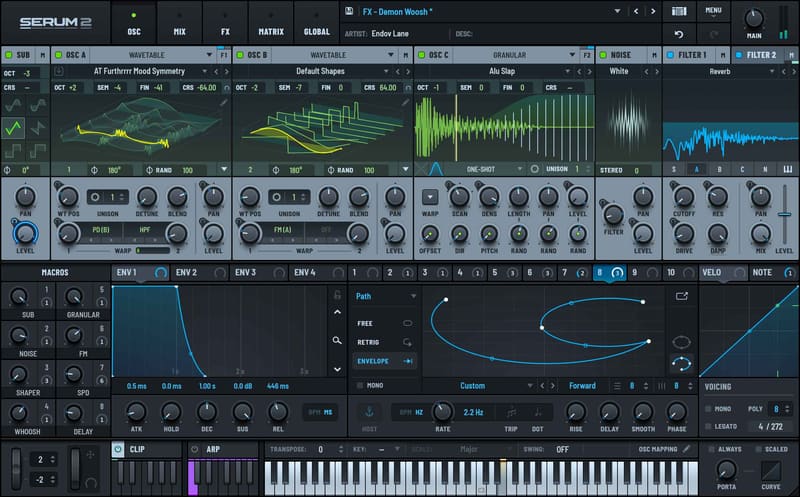
Serum is the opposite philosophy: a focused wavetable engine where you construct the sound yourself and watch every harmonic move. Its drag-and-drop wavetable editor, visual modulation and unmatched preset and tutorial ecosystem have made it the default for modern EDM and bass design, and Serum 2's added sample, granular and spectral engines widen its reach without diluting that focus. Festival producers like Axwell walk through their own Serum patches in the Axtone Academy series.
This comparison is really a choice between browsing and building. Omnisphere gives you a world-class library to explore, tweak and layer, which is why composers on deadlines love it: the sound you need probably already exists inside it. Serum gives you a transparent machine for designing signature sounds from nothing, with the biggest ecosystem in production behind it.
Price frames it too: Omnisphere costs twice as much, and earns it through the library rather than the synthesis. If you score, produce ambient, or want endless inspiration on tap, Omnisphere is worth the premium. If you make EDM, bass or pop and want to own your sound design, Serum is the sharper tool and the cheaper one.
Pick Omnisphere if you want a vast professional sound library and hybrid textures more than patch-building from scratch.
Pick Serum 2 if you want to design your own modern EDM and bass sounds with the biggest preset ecosystem behind you.
If you want a vast, professionally designed sound library to browse and layer, yes: nothing else ships Omnisphere's breadth. If you mainly design your own EDM and bass sounds, Serum delivers more focused tools for half the price.
Partially. Serum 2 added sample, granular and spectral engines, so it covers more textural ground than before, but it cannot replicate Omnisphere's library of over 14,000 curated sounds, which is most of what people buy Omnisphere for.
Omnisphere. Its library and hybrid engine are built for cinematic and ambient textures, and it is a fixture in professional composer templates. Serum leans toward modern EDM, bass and pop sound design.