 synth
synthArturia
Pigments 7
A flagship hybrid synth with six engines, wavetable, virtual analog, granular, sampling and more, and a colour-coded, drag-and-drop modulation workflow. The most-cited modern Serum alternative.
Arturia Pigments 7 reviewed: how the six-engine hybrid synth stacks up as the most complete modern alternative to Serum, and who it actually suits.
Written and reviewed by Kasper Nods. Updated July 2026. How PlugPick reviews
PlugPick is reader-supported. We may earn a commission from links on this page, at no extra cost to you. Learn more
synthArturia
A flagship hybrid synth with six engines, wavetable, virtual analog, granular, sampling and more, and a colour-coded, drag-and-drop modulation workflow. The most-cited modern Serum alternative.
★ 4.5 / 5
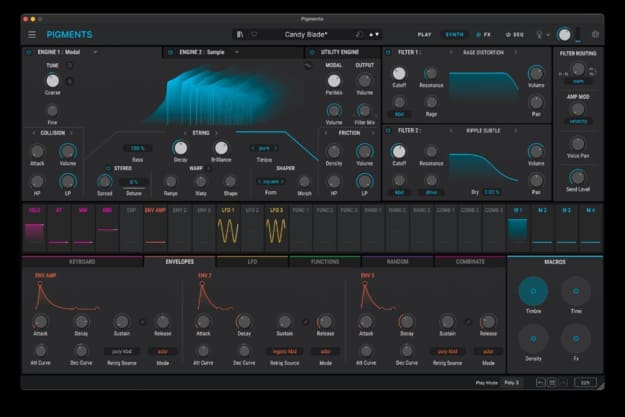
Pigments answers a simple question well: what if one synth just had every major synthesis method under one roof, wired together with a modulation system anyone can read at a glance. Six engines, a colour-coded matrix, and a browsing workflow built for speed make it the most complete hybrid synth on the market, and the plugin most often named in the same breath as Serum.
Arturia spent years building its reputation on modelled analog hardware before Pigments arrived and asked a different question: instead of emulating one classic synth, why not put every major synthesis method behind a single, coherent interface? Pigments packs wavetable, virtual analog, sample, granular and additive/harmonic engines into one instrument, plus a utility engine for noise and basic waveforms, so a single patch can layer a wavetable pad against a granulated field recording without leaving the plugin.
What actually makes that breadth usable is the modulation system. Every source, envelopes, LFOs, macros, even audio-rate modulators, gets a colour, and dragging one onto a target draws a coloured ring around it showing depth and polarity at a glance. Combined with a two-axis XY pad and a browser that lets you filter presets by engine, genre or character, Pigments turns "six synthesis engines" from an intimidating spec sheet into something you can actually navigate mid-session.
That completeness is exactly why Pigments has become the plugin most commonly cited as the modern alternative to Serum, it covers the same wavetable ground and then several genres beyond it. Producer duo Flosstradamus, who've used Arturia gear since its early hardware-modelling days, called the synth "so dope" when talking through their setup, and that kind of long-term Arturia loyalty carrying over to Pigments specifically says something about how far the plugin has come from the company's analog-modelling roots.
The honest limits show up at the edges of that breadth. Stacking multiple heavy engines, especially granular or additive layers, costs real CPU, more than a single-engine wavetable synth ever will. And because Pigments is built to do everything well rather than one thing distinctively, it lacks the singular sonic signature of a tool like Vital's spectral warping, patches read as "well-crafted" more often than "unmistakably Pigments." Newer producers can also find six engines genuinely overwhelming before the browser and presets teach them where to look.
None of that changes the bottom line. For sound designers who want maximum synthesis range in one plugin, and don't want to run three specialist synths to get it, Pigments is the most complete answer available today.
Buy it if you want maximum synthesis range in a single plugin, work across genres, or want the closest thing to a one-synth studio.
Skip it if you want a synth with one strong, distinctive sonic identity rather than broad coverage, look at Vital or Serum's wavetable focus instead.
Six: wavetable, virtual analog, sample, granular, additive/harmonic, and a utility engine for noise and basic waveforms. A single patch can layer several of them at once.
They cover overlapping ground, but Pigments' six engines give it more raw synthesis range, while Serum stays ahead on wavetable-editing depth and its preset/tutorial ecosystem. Pigments is the closest thing to a one-synth studio; Serum is the deeper specialist in its lane.
Single-engine patches are reasonable, but stacking multiple heavy engines, especially granular or additive layers, costs real CPU. Expect to freeze busy multi-engine tracks on older machines.