 synth
synthReveal Sound
Spire
Four oscillators, four filters, and a sound that sits in a mix without fighting for space. A go-to for progressive house and trance leads that cut through.
Reveal Sound Spire reviewed: the progressive house and trance lead synth that made its name cutting through a mix, and whether it still earns a place in 2026.
Written and reviewed by Kasper Nods. Updated July 2026. How PlugPick reviews
PlugPick is reader-supported. We may earn a commission from links on this page, at no extra cost to you. Learn more
synthReveal Sound
Four oscillators, four filters, and a sound that sits in a mix without fighting for space. A go-to for progressive house and trance leads that cut through.
★ 4 / 5
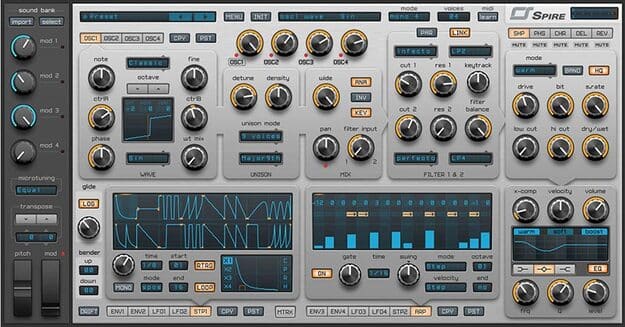
Spire built its reputation in one specific lane: EDM and progressive house leads that sit in a mix without fighting for space, and years later that reputation still holds. Four oscillators and four filters aren't a spec sheet that impresses next to a six-engine hybrid synth, but the sound Spire makes is still the sound a lot of festival records are built on.
Spire arrived at a moment when big-room and progressive house needed a specific kind of lead, bright, wide, and mix-ready without hours of EQ work, and it built its whole reputation around delivering exactly that. Four oscillators feeding four filters is a modest spec next to today's six-engine hybrid synths, but the combination of Reveal Sound's filter design and a generous unison/detune section gives Spire a sound that reads as far more "analog" than its fully digital engine would suggest.
That sound became genuinely embedded in a scene. Dutch trio Showtek named Spire alongside their hardware Virus TI as "close to our all-time favorite," which is a serious compliment from producers whose reference point is a classic analog-modelling synth, not another plugin. Brooks released an official producer pack of 128 custom Spire presets through STMPD RCRDS, and trance producer ReOrder sells signature Spire soundsets built from his own FSOE and Black Hole Recordings releases, the kind of artist-level adoption that only happens when a synth's sound actually holds up on festival systems.
Where Spire shows its age is breadth. Next to Pigments' six engines or Serum's wavetable-plus-granular-plus-spectral stack, four oscillators and four filters is a narrow toolset, and Spire's arpeggiator and modulation options feel dated compared to what modern hybrid synths ship as standard. It was built to do one thing, cut-through EDM leads, extremely well, not to be an all-rounder.
That narrowness is also the honest reason to think twice before buying it today. If you're chasing that specific sound, the one Showtek, Brooks and ReOrder all reach for, Spire still delivers it faster than almost anything else. If you want a synth that can also do ambient pads, granular textures or ten other jobs, look elsewhere first.
Buy it if you produce EDM, progressive house or trance and want the specific cut-through lead sound the genre's biggest names already use.
Skip it if you want one synth that covers many genres and sound-design tasks, Pigments or Serum will get you further.
If you're chasing its specific EDM and progressive house lead sound, yes, it still does that job faster than most modern alternatives. As a general-purpose synth for varied genres, newer hybrid synths like Pigments or Serum cover more ground.
Bright, wide leads and plucks for big-room, progressive house and trance, the sound behind official preset packs from Brooks and ReOrder and name-checked by Showtek alongside their hardware Virus TI.
Spire's four oscillators and four filters are narrow next to Pigments' six engines or Serum's wavetable-plus-granular stack. It trades breadth for a distinctive, proven sound in one specific lane.